Automating SME work and infrastructure with ADKPart 11 of 11
Reviewing a Year of Work: Using ADK to Organize Improvements and Next Year’s Automation Plan
Review business improvements with ADK using clear outcomes, human time, exceptions, and comparison limits. Choose next-year priorities and prepare a practical handover.

In this article
What you will learn
Do not count AI executions as business completions.
Show review, corrections, exceptions, maintenance, and outstanding work.
Retain comparison limits and choose one change for next month.
Part 11, closing the year-end practice series | From AI usage counts to business outcomes and next year’s priorities. Information verified as of October 14, 2026.
“How many times did we use AI this year?” “How much more should we automate next year?” These two questions alone do not show how work changed. Drafts may have been regenerated more often without reducing sales review time. Inquiries may have been classified automatically while the same person still searches again for information on pending cases.
The review should establish whose work moved forward, under which conditions, and what checking and exceptions remained. Agents built with Google Agent Development Kit (ADK) can gather material from records and organize differences and unknowns. People then check that material and decide next year’s scope and responsibilities.
The year-end practice series follows the eight-part foundation series and connects everyday operations to year-end checks and planning. This closing article designs the handoff from improvement records to the next month’s work.
This design article is intended for publication on December 29, 2026. Research was conducted as of October 14, so it is not a report of verified year-end 2026 results. We use hypothetical Company A, an equipment and parts distributor with 35 employees, including three salespeople. All monthly volumes, times, costs, comparisons, and meeting procedures below are assumptions. Replace them with actual records checked by your own staff.
Return the year-end question to business completion
Start by restating the outcome expected at the beginning of the year or at adoption. For Company A, it is: “Give the salesperson a quotation draft with the required information even during busy periods, while reducing missed checks and rework.” Use the JTBD approach introduced in Article 1 as the entry point for the review.
Distinguish a generated draft from a draft received in a usable state by its reviewer. Sending it to the customer, receiving an order, and recording revenue are further stages. Draft usage records do not establish order growth.
Bring three questions to the meeting: should this task continue, what should be fixed first, and who will check next month’s change? Agent counts and new models should not be the main explanation of results.
Learn from the structure connecting analysis and decisions
In April 2026, Revionics announced general availability of its ADK-based Multi-Agent Pricing System. The product connects analysis, forecasts, business rules, and execution, but the announcement does not disclose customer-specific labor savings or ROI. Revionics’ official announcement
Our SME adaptation separates reading records, proposing candidates, and defining execution conditions. At Company A, an agent organizing year-end records does not automatically turn them into next year’s approved plan. Staff review evidence and workload before deciding.
The following design concerns a business-improvement review, not pricing changes or corporate investment recommendations. A publicly available product does not establish that your company will achieve the same profit or staffing reductions.
State the scope and unobserved periods first
A report titled “annual improvements” does not contain a full year of observations if AI was introduced partway through the year. State the task, department, start of use, reporting cutoff, and periods without records.
Company A could cover quotation preparation for existing customers and standard products, recording custom products and contractual exceptions separately. If scope expanded during the period, record when and what was added instead of merging the before-and-after counts without distinction.
For cases continuing into the next month, distinguish intake month, cost-incurrence month, and completion month. Do not remove pending year-end cases or shift them to the following year merely to improve the current year’s figures.
Begin the report with verified scope, missing records, and exclusions. Do not treat blanks as zeros. Assign a person and review date to missing information. Explaining why a figure remains unknown is more useful than asking AI to guess it.
Assign record gathering and explanation to ADK
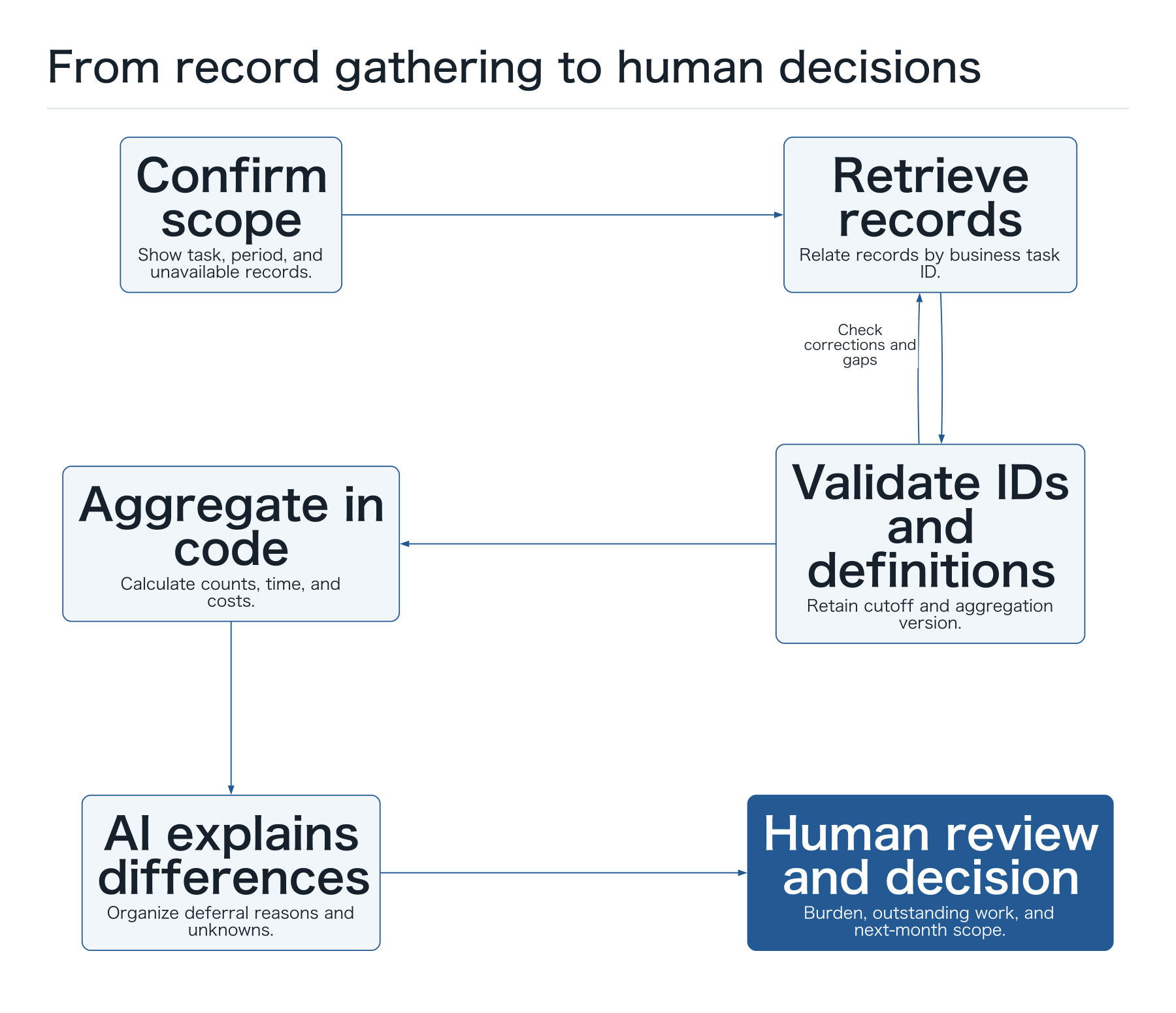
Our design separates access to the business register, execution history, review records, and cost aggregation. Relate them using business task IDs and preserve retrieved periods, counts, and timestamps. Check department and customer access rights at retrieval.
AI classifies deferral reasons and short staff notes, explaining where problems recur. Ordinary code aggregates counts, time, cost, and rates under defined rules. People check classifications, their business meaning, and next month’s scope.
The flow is scope confirmation → record retrieval → ID and aggregation validation → calculation → explanation of differences and unknowns → human review. Before an agent writes that something improved, show which records were compared and against what.
Unavailable registers leave their scope unverified. Do not fill completion counts or costs from conversation memory. Bind saved explanations to the source versions and aggregation definitions so that the numbers can be checked later.
 Open full-size diagram
Separate business counts from AI executions
One quotation case may involve rereading an attachment, retrieving a product, and regenerating a draft. Three executions do not mean three completed business tasks. Keep business task IDs separate from execution IDs.
Record: Intake count
Meaning at Company A: Eligible inquiries received
Year-end check: Treatment of duplicates and exclusions
Record: Business completions
Meaning at Company A: Drafts whose conditions were checked and received by a reviewer
Year-end check: Whether completion criteria changed
Record: Deferrals and failures
Meaning at Company A: Awaiting information, retrieval failures, or review
Year-end check: Who acts next and what remains
Record: AI executions
Meaning at Company A: Extraction, regeneration, and retries
Year-end check: Whether repetition increased within the same task
Record: External outcomes
Meaning at Company A: Results of sending or registration when in scope
Year-end check: Agreement with conversational completion messages
Classification alone does not complete a case. Link returned work to the business task ID. When several departments review the same item, include their human time without counting the business task several times.
Attach denominator definitions to the year-end report. Knowing how many eligible cases were checked separates increased usage from the share of work that progressed.
Bind record corrections to an aggregation version
Staff may later correct handling time or completion state. A year-end report using the earlier values will not reconcile with the revised register. Give each aggregation a cutoff and version, and record changed fields, reasons, and reviewers.
Do not enter a case with no time record as zero minutes in an average. Separate cases with verified time from those without records. If an additional staff check supplied a missing value, record the method. Estimated time inferred by AI from similar cases must not enter the measured-time column.
When a figure is corrected after the meeting, check which decisions it affects. If cost or completion counts change, do more than edit the number in the prose while leaving the plan unchanged: assign someone to reconsider priorities. Make aggregation corrections and business-plan changes separately traceable.
Use a hypothetical monthly report to show pending work and burden
Assume 80 eligible cases in one reporting month. A reviewer checked the conditions and received a draft for 60; 12 await customer information; and 8 were handed back after retrieval failed. Thus 80 = 60 + 12 + 8, and the business completion rate is 60 ÷ 80 = 75%.
Even if AI generated drafts 92 times, completions remain 60. Regeneration of the same case is included in the 92. Retain an owner and next action for all 20 pending or failed cases.
Illustrative record: Eligible intake
Value: 80 cases
Interpretation: Do not count the same task ID twice
Illustrative record: Draft received after review
Value: 60 cases
Interpretation: Not completion of customer sending or an order
Illustrative record: Awaiting additional information
Value: 12 cases
Interpretation: Unfinished until a response arrives
Illustrative record: Handoff after retrieval failure
Value: 8 cases
Interpretation: Human acceptance does not necessarily complete a draft
Illustrative record: Draft generation
Value: 92 executions
Interpretation: Not a denominator for business cases
Assume retrieved direct usage charges of ¥32,000 and allocated shared costs of ¥8,000. The ¥40,000 total divided by 60 completions is about ¥667. This divides the month’s usage costs by its completions. It includes usage costs for unfinished cases but excludes human time and development costs.
If pending work finishes next month, incurred costs and completions fall into different periods. Review monthly costs and cumulative costs through case completion separately, according to the question. Do not call ¥667 the full cost or profitability of one case.
Include review, corrections, failures, and maintenance in human time
In the same hypothetical month, ordinary review for 60 completed cases at six minutes each takes 360 minutes, or six hours. Exception handling for the other 20 at 15 minutes each takes 300 minutes, or five hours. Adding two hours of corrections outside ordinary review and three hours of maintenance and evaluation gives 16 hours.
Those 16 hours are human handling time during the period in which 80 cases were handled, not time to complete all 80. Define categories to avoid counting the same work as both exception handling and additional correction. Record waiting separately from hands-on work.
Check comparable tasks and completion states when contrasting this with earlier records. If the former process finished everything while the new process leaves 20 cases pending, shorter total time alone is not improvement. Include the outstanding work and burden needed to finish it.
Recovered time used elsewhere does not necessarily reduce payroll spending. Separate time-value conversions, actual overtime or outsourcing changes, and revenue or profit. Do not turn a handling-time difference directly into cash savings in the year-end report.
Do not attribute a before-and-after difference entirely to ADK
HM Treasury’s evaluation guidance distinguishes observing an outcome change from attributing it to an intervention. Other factors can affect a simple before-and-after comparison. This is policy-evaluation guidance, not research measuring ADK outcomes. HM Treasury’s evaluation guidance
Company A also records product-master cleanup, staff changes, busy periods, customer mix, and intake changes. If price lists were consolidated when AI was introduced, that cleanup may also explain shorter search time.
With few monthly cases, do not select only convenient examples. Separate normal cases and exceptions and compare similar task types with similar input detail. Leave room to say: “We observed shorter handling time, but the contribution of each change remains unverified.”
Compare similar cases and retain the limitations
One proposed check for the following month is to process completed historical cases through both the previous procedure and the new draft assistance. Align inputs, product-data versions, scope, and expected deliverables, then record review and corrections in both approaches.
For example, assume 40 comparison cases took ten minutes each under the earlier method. The new method takes six minutes of review plus two minutes of corrections, or eight minutes each. The difference is two minutes per case and 80 minutes across 40 cases. This excludes shared maintenance and adoption costs; it is not a company-wide saving.
When the same person handles the same case twice, memory and execution order affect the comparison. Record selection, reviewers, order, and the fact that cases were reprocessed. Do not describe this comparison alone as proof of an independently established causal effect.
Retain cases not used for comparison. Replacing examples to suit the improvement makes everyday applicability unclear. Use the check to repair drafts and information handoffs rather than rate salespeople.
Aggregate annual rates from counts, not simple monthly averages
For records with the same definitions, combine numerators and denominators. Suppose one illustrative month has one error among ten inspected cases, and another has five among 100. Monthly rates are 10% and 5%, but the combined rate is 6 ÷ 110, approximately 5.5%. That differs from the simple average of 7.5%.
Different inspection scopes and selection methods still require care. Do not mix full inspection and exception-only inspection into one undifferentiated quality metric. Show denominators, inspection methods, and scope differences.
If you observed operations for only several months, report results for that period. Do not multiply the illustrative 16-hour month by 12 and call it an annual result. If forecasting next year, state assumptions about volumes, busy periods, maintenance, and scope, and keep the forecast separate from observed results.
Use PDCA to turn aggregation into one small change
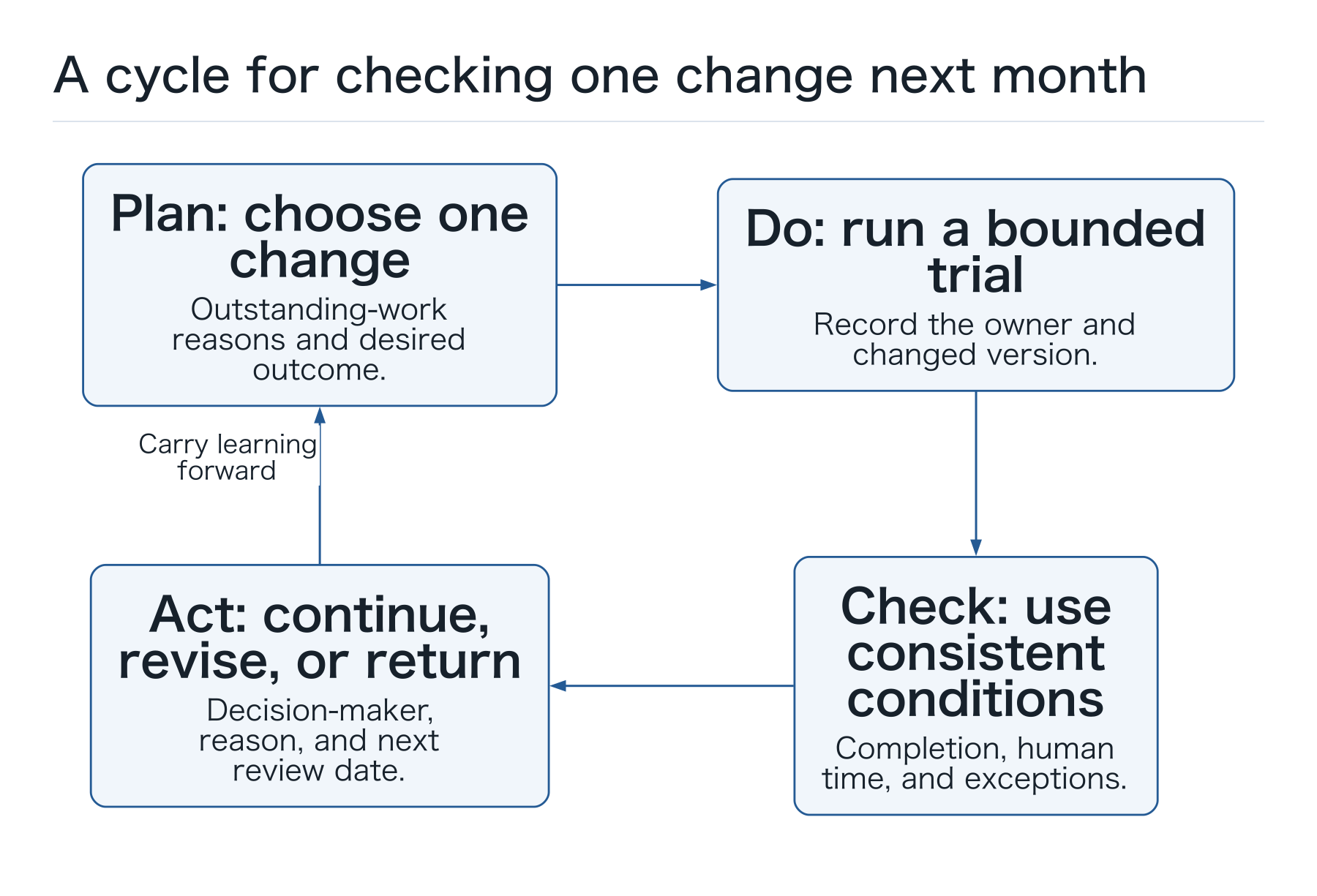
ASQ describes PDCA as repeating planning, a small trial, review of results, and action based on learning. ASQ’s PDCA explanation
Company A applies it as follows at the year-end meeting. This is a monthly review and next-change table, rather than another version of Article 8’s 90-day adoption plan.
Stage: Plan
Work connecting year-end to next month: Choose one handoff to improve from unfinished-work reasons
Record: Desired outcome, scope, and expected change
Stage: Do
Work connecting year-end to next month: Trial one change within authorized scope
Record: Action, owner, and changed version
Stage: Check
Work connecting year-end to next month: Compare completion, human time, and exceptions under the same definitions
Record: Denominators, records, unknowns, and other changes
Stage: Act
Work connecting year-end to next month: Decide to continue, revise, or return to the previous method
Record: Decision-maker, reason, and next review date
Suppose missing quantity information is common among the 12 cases awaiting customer details. A candidate for next month is to repair the quantity field and question drafts in the intake form. Before adding fully automated sending, check whether missing information falls without increasing review burden.
 Open full-size diagram
Compare next year’s candidates by time value and failure impact
List expected human time recovered, input readiness, consequences of error, reversibility, and the owner. The following is our proposed comparison, not a standard scoring system or fixed ranking.
Candidate: Organize missing inquiry fields
Desired improvement: Reduce repeated sales clarification
Preparation and impact: Intake fields are needed; drafts can be reviewed
Initial treatment: Candidate for a small trial
Candidate: List deferral reasons and owners
Desired improvement: Reduce searching for outstanding work
Preparation and impact: A state and ownership register is needed
Initial treatment: Prioritize record preparation
Candidate: Expand automatic customer sending
Desired improvement: Reduce sending work
Preparation and impact: Wrong recipients and changed terms have consequences
Initial treatment: Establish approval and outcome checks first
Candidate: Develop a low-volume, complex workflow
Desired improvement: Support unusual requests
Preparation and impact: Significant development and maintenance; many exceptions
Initial treatment: Compare existing procedures and consider deferral
Candidates offering time value with containable impact can be checked first. Even an attractive candidate returns to preparation if authorization, authoritative inputs, or ownership are unresolved. Retain the decision not to add AI where value is small and burden is high.
For the January plan, state who will change what, with which input, and what will inform the decision. A plan alone must not expand automatic execution rights; check the approved scope separately.
Turn pending cases into concrete work after the break
Passing the illustrative 20 unfinished cases to the next year with only “sales to check” restarts the same search. For the 12 awaiting information, attach what was asked, where replies arrive, and who checks next. For the eight retrieval failures, preserve the missing information and authoritative source for manual checking.
If the usual contact is on holiday, decide who receives customer or provider replies. Contacting someone is not resolution. Use the same completion definition when a reviewer checks the conditions and receives the draft. Do not give a transferred case a new task ID and count it again as new work next year.
Before batch reprocessing next month, verify current product and condition versions. Do not reuse year-end approval for a changed quantity or recipient. Prioritize the next owner’s ability to check conditions and finish the work over simply clearing the pending list.
Finish the meeting with a handover page
A long year-end explanation does not move improvement forward if nobody knows what to check after the break. Put the following on one page.
- Business outcome: Who receives what for completion? Are sending and orders included?
- Observed scope: Targets, period, counts, exclusions, and unavailable records.
- Quality: Completion, correction, deferral, and failure denominators, with inspection scope.
- Human time: Ordinary review, additional corrections, exceptions, and maintenance; waiting separately.
- Costs: Direct charges, allocation, unallocated amounts, and excluded development or human costs.
- Outstanding work: Task ID, reason, next owner, required information, and planned review date.
- Comparison limits: Concurrent procedure, product-data, staff, and seasonal changes.
- One change next month: Desired outcome, target, proposal, and stop or reversal conditions.
- Decision and handoff: Decision-maker, reason, substitute owner, and next review date.
Retain source references and the aggregation-definition version. Verify that readers can access the evidence they need. Use references and explanations consistent with permissions, rather than copying entire confidential documents into widely shared material.
The page should make scope and unknowns clear even if ownership changes next month. Outstanding cases, authoritative records, and the next owner must remain available when AI stops; that is a condition of a usable business handover.
Hand this year’s learning to the next decision
The year-end check can proceed by setting a record cutoff, aligning scope and denominators, showing human burden and pending work, comparing candidates, and assigning owners and the next review date. Do not fill unknowns during the meeting; hand them to the person who will verify them.
Separate what improved, what fell short, and what cannot yet be compared. Even if automation is deferred, organized inputs, documents, and contacts can remain useful. Next year’s starting point is less about feature counts than being able to move one task forward with checkable evidence.
To review your business improvements and choose next year’s scope, share current procedures, case volumes, reviewers, and remaining exceptions with KONDAX. Begin with observed scope and completion criteria to make the next trial concrete.
Three checks before practice
- Can missing records remain unknown while scope and denominators are shown?
- Does outstanding work retain a task ID, next owner, and review date?
- Are next-month scope and stop or return conditions defined?